This class implements the Buffer interface using a c-array. More...
#include <StackBuffer.hpp>
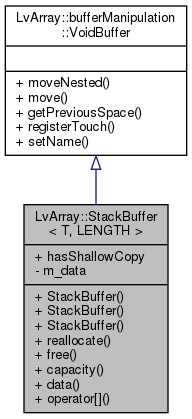
Inheritance diagram for LvArray::StackBuffer< T, LENGTH >:
Public Types | |
| using | value_type = T |
| Alias used in the bufferManipulation functions. | |
Public Member Functions | |
| LVARRAY_HOST_DEVICE constexpr | StackBuffer (bool=true) |
| Constructor for creating an empty/uninitialized buffer. More... | |
| LVARRAY_HOST_DEVICE constexpr | StackBuffer (StackBuffer const &src, std::ptrdiff_t) |
| Sized copy constructor, creates a deep copy. More... | |
| template<typename _T = T, typename = std::enable_if_t< std::is_const< _T >::value >> | |
| LVARRAY_HOST_DEVICE constexpr | StackBuffer (StackBuffer< std::remove_const_t< T >, LENGTH > const &src) |
Create a copy of src with const T. More... | |
| LVARRAY_HOST_DEVICE void | reallocate (std::ptrdiff_t const size, MemorySpace const space, std::ptrdiff_t const newCapacity) |
| Notionally this method reallocates the buffer, but since the StackBuffer is sized at compile time all this does is check that newCapacity doesn't exceed LENGTH. More... | |
| LVARRAY_HOST_DEVICE constexpr void | free () |
| Free the data in the buffer but does not destroy any values. More... | |
| LVARRAY_HOST_DEVICE constexpr std::ptrdiff_t | capacity () const |
| LVARRAY_HOST_DEVICE constexpr T * | data () const |
| template<typename INDEX_TYPE > | |
| LVARRAY_HOST_DEVICE constexpr T & | operator[] (INDEX_TYPE const i) const |
 Public Member Functions inherited from LvArray::bufferManipulation::VoidBuffer Public Member Functions inherited from LvArray::bufferManipulation::VoidBuffer | |
| void | moveNested (MemorySpace const space, std::ptrdiff_t const size, bool const touch) const |
| Move the buffer to the given execution space, optionally touching it. More... | |
| void | move (MemorySpace const space, bool const touch) const |
| Move the buffer to the given execution space, optionally touching it. More... | |
| MemorySpace | getPreviousSpace () const |
| void | registerTouch (MemorySpace const space) const |
| Touch the buffer in the given space. More... | |
| template<typename = VoidBuffer> | |
| LVARRAY_HOST_DEVICE void | setName (std::string const &name) |
| Set the name associated with this buffer. More... | |
Static Public Attributes | |
| static constexpr bool | hasShallowCopy = false |
| Signifies that the StackBuffer's copy semantics are deep. | |
Private Attributes | |
| T | m_data [LENGTH] |
| The c-array containing the values. | |
Detailed Description
template<typename T, int LENGTH>
class LvArray::StackBuffer< T, LENGTH >
This class implements the Buffer interface using a c-array.
- Template Parameters
-
T type of data that is contained in the buffer. T must be both trivially copyable and trivially destructable. LENGTH the length of the buffer.
- Note
- Unlike the standard Buffer classes the StackBuffer does not permit making shallow copies.
- The parent class provides the default execution space related methods.
Constructor & Destructor Documentation
◆ StackBuffer() [1/3]
template<typename T , int LENGTH>
|
inline |
Constructor for creating an empty/uninitialized buffer.
- Note
- For the StackBuffer an uninitialized buffer is equivalent to an empty buffer.
◆ StackBuffer() [2/3]
template<typename T , int LENGTH>
|
inline |
Sized copy constructor, creates a deep copy.
- Parameters
-
src The buffer to be coppied.
◆ StackBuffer() [3/3]
template<typename T , int LENGTH>
template<typename _T = T, typename = std::enable_if_t< std::is_const< _T >::value >>
|
inline |
Create a copy of src with const T.
- Template Parameters
-
_T A dummy parameter to allow enable_if, do not specify.
- Parameters
-
src The buffer to copy.
Member Function Documentation
◆ capacity()
template<typename T , int LENGTH>
|
inline |
- Returns
- Return the capacity of the buffer.
◆ data()
template<typename T , int LENGTH>
|
inline |
- Returns
- Return a pointer to the beginning of the buffer.
◆ free()
template<typename T , int LENGTH>
|
inline |
Free the data in the buffer but does not destroy any values.
- Note
- For this class this is a no-op since T must be trivially destructable.
◆ operator[]()
template<typename T , int LENGTH>
template<typename INDEX_TYPE >
|
inline |
- Template Parameters
-
INDEX_TYPE the type used to index into the values.
- Returns
- The value at position
i.
- Parameters
-
i The position of the value to access.
- Note
- No bounds checks are performed.
◆ reallocate()
template<typename T , int LENGTH>
|
inline |
Notionally this method reallocates the buffer, but since the StackBuffer is sized at compile time all this does is check that newCapacity doesn't exceed LENGTH.
- Parameters
-
size The current size of the buffer, not used. space The space to perform the reallocation in, not used. newCapacity the new capacity of the buffer.
The documentation for this class was generated from the following file:
- /home/docs/checkouts/readthedocs.org/user_builds/lvarray/checkouts/latest/src/StackBuffer.hpp
